Architecture
Overview
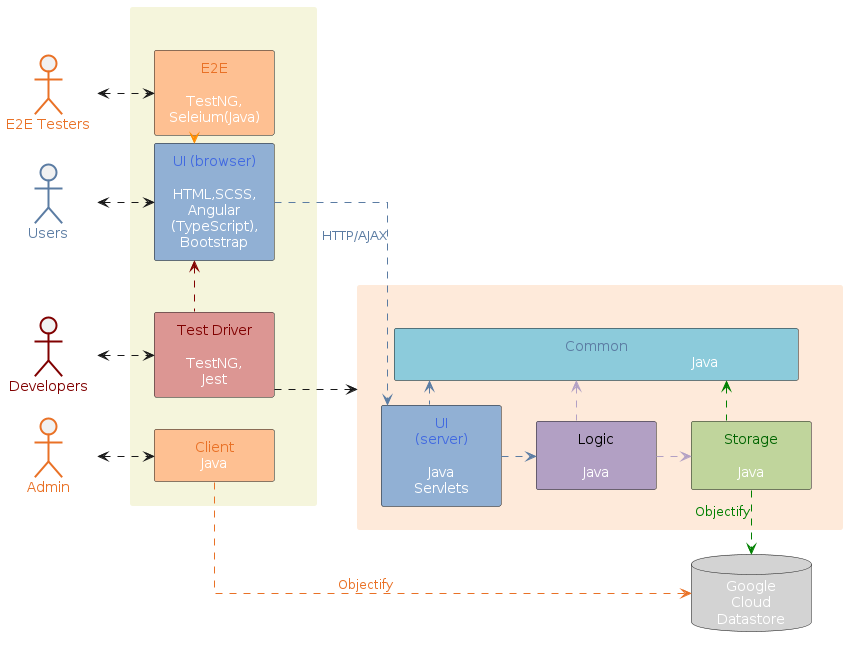
TEAMMATES is a web application with the following main components:
- UI (Browser): A single-page application built with Angular, served over HTTP with subsequent data requests sent asynchronously.
- UI (Server): A RESTful controller serving as the entry point for backend logic.
- Logic: The business logic of the application.
- Storage: The data persistence layer.
- Common: Shared utility code, helper classes, and data transfer objects used across the application.
The following additional components are used for testing:
- Test Driver: Automated regression testing using
TestNG(Java) andVitest(TypeScript). - E2E: End-to-end testing using
Seleniumto interact with the application via a web browser.
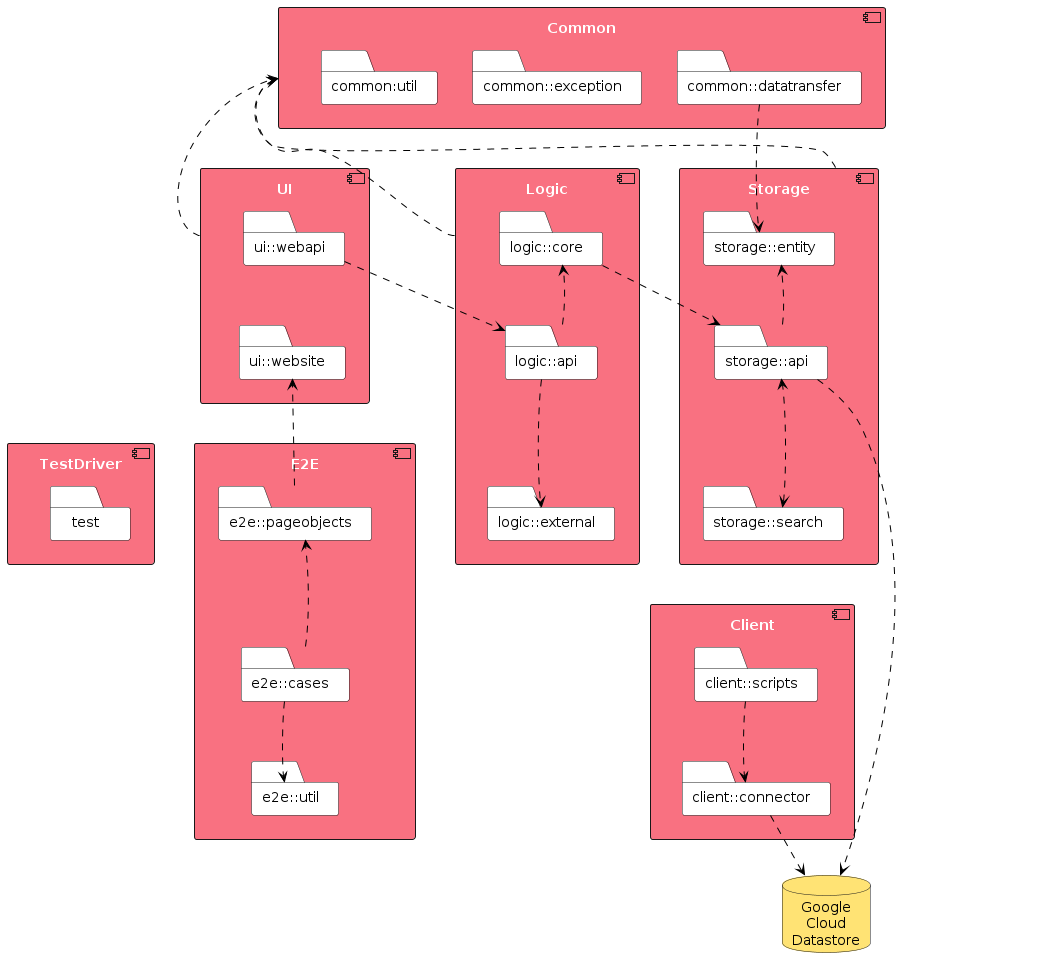
The diagram below shows how each component is organised into packages and the dependencies between them.
UI Component
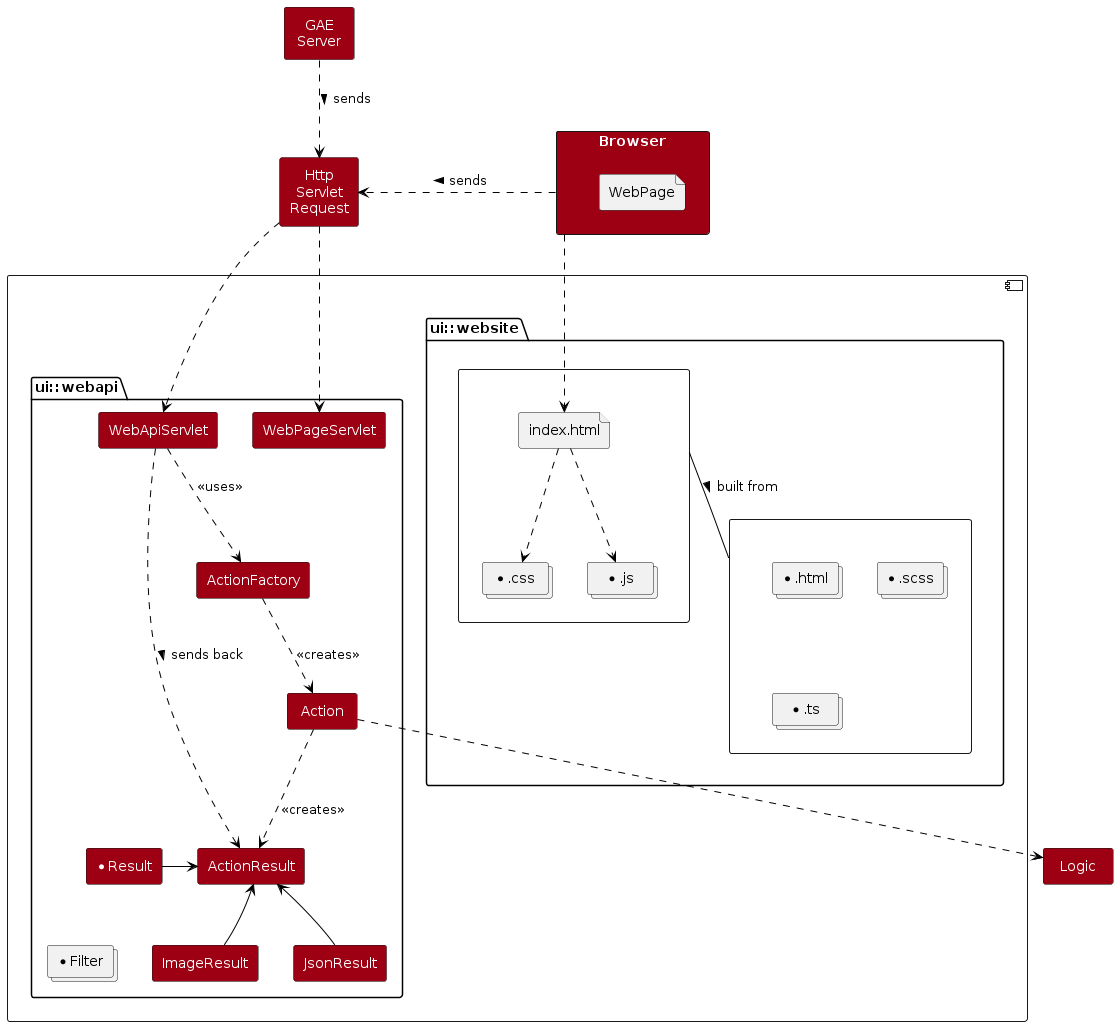
The UI component is the entry point for all requests received by the application. Incoming requests pass through custom filters (e.g. OriginCheckFilter) before being forwarded to the appropriate *Servlet for processing.
The frontend (ui::website) is not a Java package — it is an Angular application consisting of HTML, SCSS, and TypeScript files, built into standard HTML, CSS, and JavaScript for the browser.
Request Processing
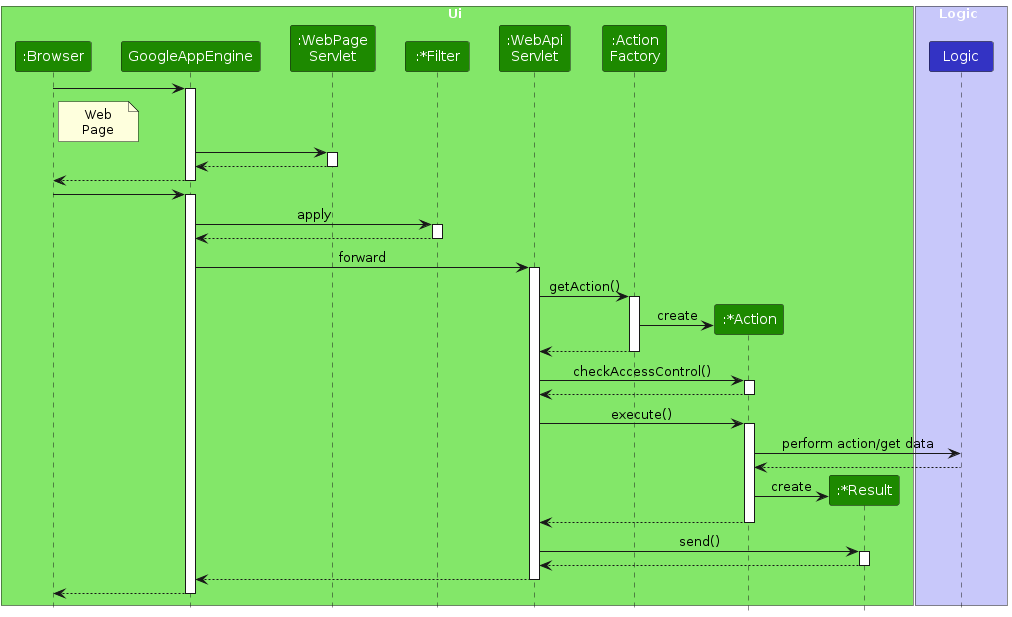
The initial page request is handled as follows:
WebPageServletreturns the built single web page (index.html).- The browser renders the page and executes the page scripts, triggering HTTP requests to the server.
Subsequent HTTP requests are handled as follows:
WebApiServletusesActionFactoryto generate the matchingActionobject, e.g.GetFeedbackSessionsAction.- The
Actionobject checks the user's access rights, performs the action, and packages the result into anActionResultobject. WebApiServletreturns the result to the browser.
Static asset files (CSS, JS, images) are served directly.
The Web API is protected by two layers of access control:
- Origin check: Mitigates CSRF attacks.
- Authentication and authorization check: Verifies the logged-in user has sufficient privileges.
Template Method pattern
We use the Template Method pattern to abstract the process flow into the Action classes.
Policies
Access control: The UI is expected to check access control using the GateKeeper class.
Transaction management: A Hibernate session and transaction is opened per request.
Request validation: Request parameters are validated at this layer.
Logic Component
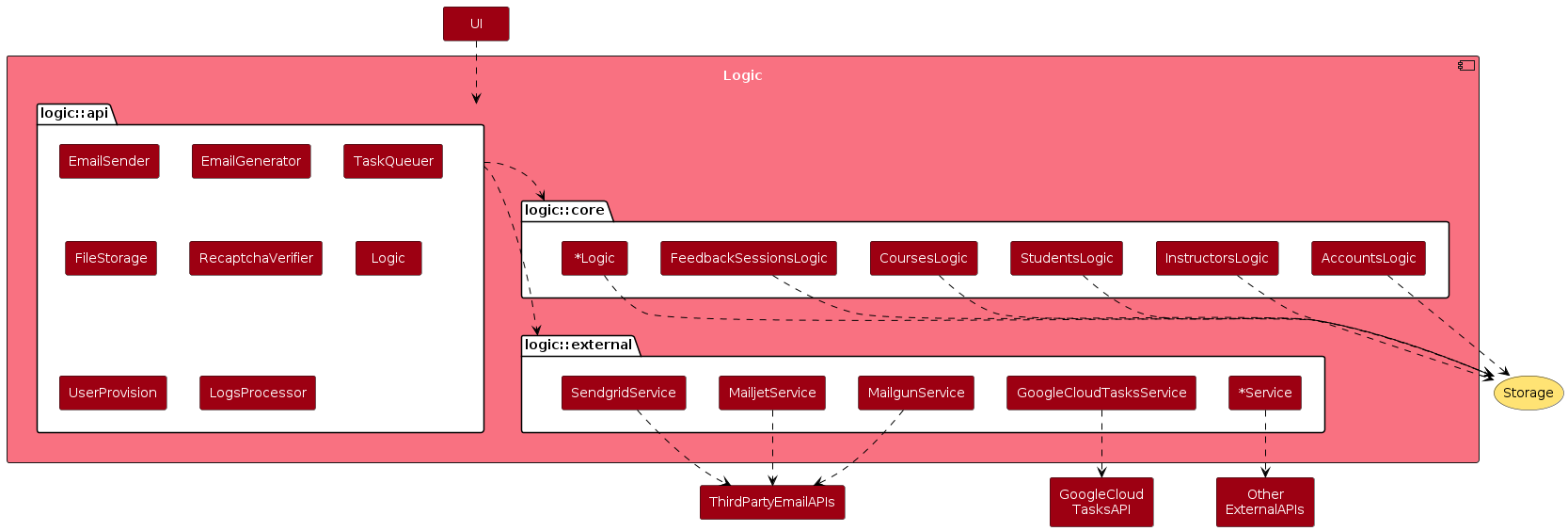
The Logic component handles the business logic of TEAMMATES, including validating business constraints, sanitizing input from the UI, and integrating with third-party services such as email providers.
Package overview:
logic.api: Provides the API of the component to be accessed by the UI.logic.core: Contains the core logic of the system.logic.external: Holds the logic of external services integration.
Logic API
The Logic API is represented by the following classes:
Logic: A Facade connecting to the various*Logicclasses to handle business logic and access theStoragecomponent.UserProvision: Retrieves user information from request cookies.AuthProxy: Provides authentication-related services.RecaptchaVerifier: Verifies reCAPTCHA tokens.
Many classes in this layer use environment-based implementations — connecting to real production services in staging/production and local alternatives in development.
Policies
API for creating entities:
- Null parameters: Causes an assertion failure.
- Invalid parameters: Throws
InvalidParametersException. - Entity already exists: Throws
EntityAlreadyExistsException(escalated from Storage level).
API for retrieving entities:
- Null parameters: Causes an assertion failure.
- Entity not found: Returns
null, allowing read operations to double as existence checks.
API for updating entities:
- Entity not found: Throws
EntityDoesNotExistException. - Invalid parameters: Throws
InvalidParametersException.
API for deleting entities:
- Entity not found: Fails silently — if it does not exist, it is as good as deleted.
- Cascade policy: When a parent entity is deleted, all entities with referential integrity to it are also deleted.
Storage Component
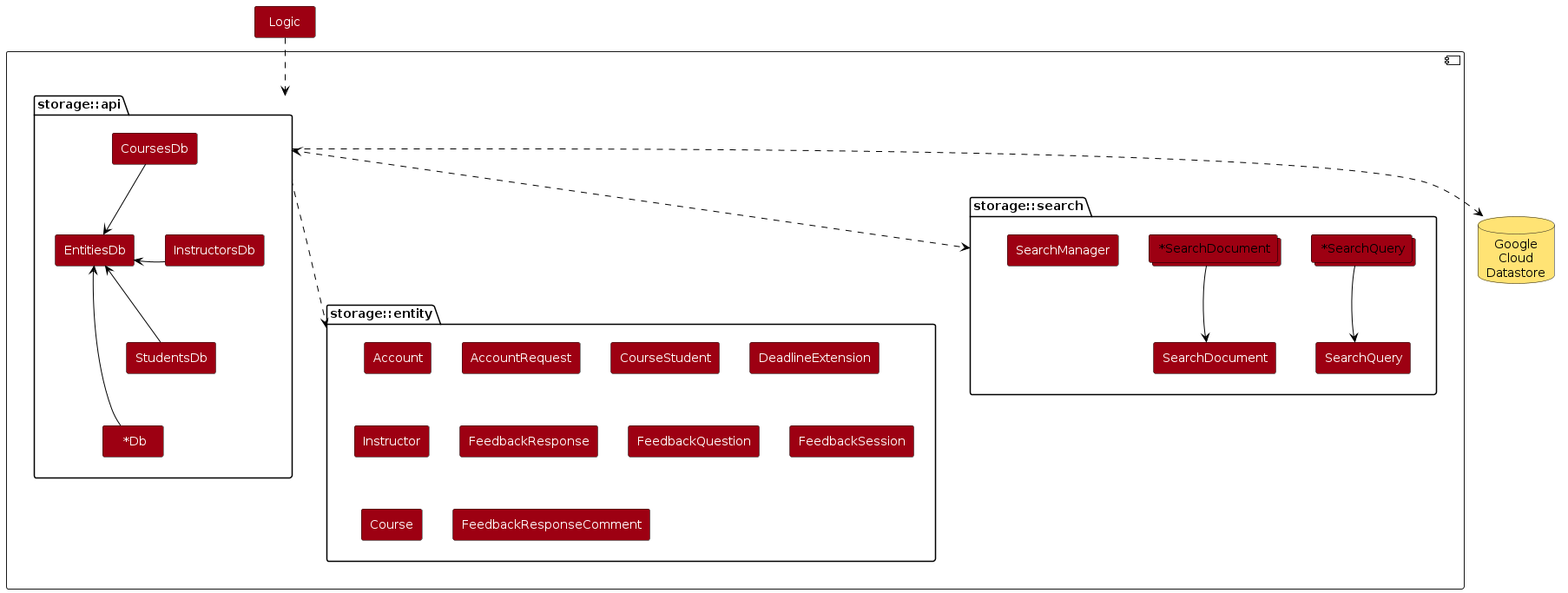
The Storage component performs CRUD operations on data entities. It contains minimal logic beyond what is directly relevant to persistence. Cascade operations are handled at the database level.
It is responsible for:
- Enforcing database constraints on entities.
- Hiding database complexity from the
Logiccomponent.
Package overview:
storage.api: Provides the API accessed by the Logic component.storage.entity: Persistable entity classes.
Storage API
Represented by the *Db classes. These classes act as the bridge to the database.
Policies
API for creating: Duplicate entities will result in a Hibernate constraint violation exception.
API for retrieving: Returns null if the entity does not exist.
API for updating: Missing or invalid entities will result in a Hibernate exception.
API for deleting: Delete operations are passed directly to the database. Existence checks and silent delete behaviour are handled by the Logic component.
Common Component
The Common component contains common utilities used across TEAMMATES.
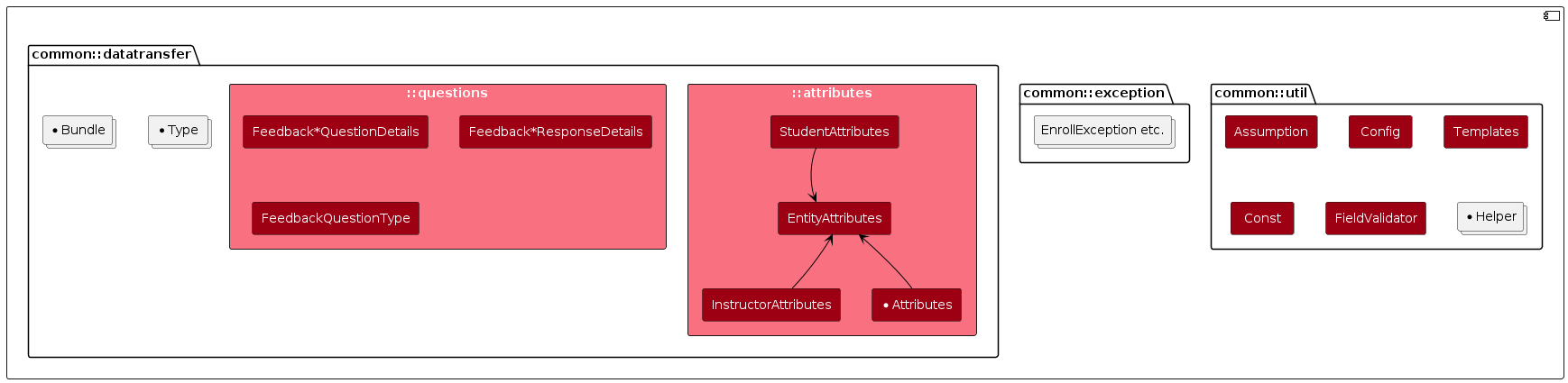
Package overview:
common.util: Contains utility classes.common.exceptions: Contains custom exceptions.common.datatransfer: Contains data transfer objects.